AI in Finance is bringing about a monumental shift in the way banking, trading, and fraud detection are conducted. With the rising integration of artificial intelligence technology, financial institutions are experiencing greater efficiency, accuracy, and security in their operations. From automating mundane tasks to predicting market trends, AI is reshaping the finance industry by offering innovative solutions that enhance customer experience and streamline processes. In this article, we will explore the transformative power of AI in revolutionizing the financial landscape.

Role of AI in Banking
Improving customer experience
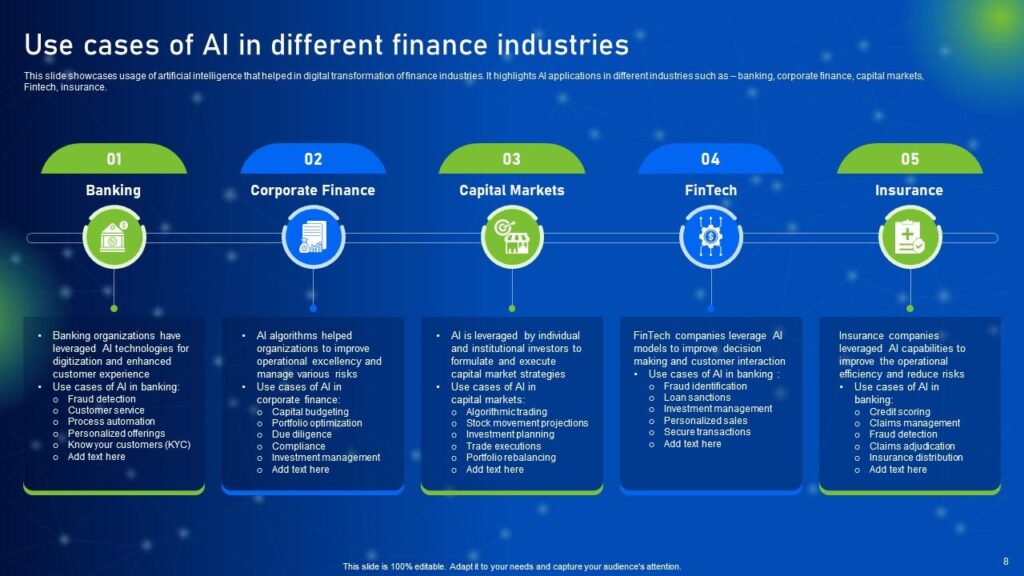
AI has been playing a crucial role in transforming the banking industry by enhancing the overall customer experience. With the help of AI-powered chatbots and virtual assistants, banks are now able to provide efficient and personalized customer service round the clock. These AI-based systems can understand natural language and provide accurate responses to customer queries, making it easier and more convenient for customers to get the information they need.
Moreover, AI technology enables banks to analyze customer data and anticipate their needs, allowing for customized product recommendations and tailored offers. This not only improves customer satisfaction but also increases the likelihood of cross-selling and upselling opportunities. By leveraging AI, banks can provide a seamless and personalized banking experience, making customers feel valued and cared for.
Streamlining operations
In addition to enhancing the customer experience, AI is instrumental in streamlining banking operations. AI-powered automation systems can process large amounts of data quickly and accurately, significantly reducing the manual effort required for tasks such as data entry and document processing. This not only saves time but also minimizes the risk of human error, leading to increased efficiency and productivity.
AI can also be utilized to automate backend processes, such as loan underwriting and account opening procedures. By automating these time-consuming and repetitive tasks, banks can streamline their operations and allocate resources more effectively. This allows bank staff to focus on more complex and value-added activities, such as providing strategic financial advice to customers. Overall, AI enables banks to improve their operational efficiency and deliver services more promptly and accurately.
Risk assessment and management
Another area where AI has made a significant impact in banking is risk assessment and management. By leveraging machine learning algorithms, banks can analyze vast amounts of historical and real-time data to identify patterns and assess risks more effectively. AI can detect anomalies in financial transactions and flag suspicious activities, helping banks in combating fraud and ensuring compliance with regulatory requirements.
Moreover, AI can aid banks in making more accurate credit decisions by analyzing customer data and credit risk factors. By utilizing sophisticated risk assessment models, AI can estimate the creditworthiness of individuals and businesses, reducing the risk of default and improving the overall quality of the loan portfolio. This not only enhances the profitability of banks but also promotes financial stability in the industry.
In summary, AI plays a crucial role in transforming the banking industry by improving customer experience, streamlining operations, and enhancing risk assessment and management. This technology has immense potential to revolutionize the way banks operate and serve their customers, ultimately leading to a more efficient and customer-centric banking ecosystem.
AI in Trading
Automated trading systems
AI-powered automated trading systems have revolutionized the way trading is conducted. These systems utilize algorithms to analyze vast amounts of market data, identify trading opportunities, and execute trades automatically without human intervention. The algorithms can process information at a speed and scale that is beyond human capabilities, enabling traders to take advantage of even the smallest market fluctuations.
Automated trading systems can execute trades with precision and speed, eliminating emotions and biases that can often cloud human judgment. This results in more objective and disciplined trading decisions, leading to improved trading performance. Additionally, AI can continuously learn from market data and adjust trading strategies accordingly, enhancing the system’s ability to adapt to changing market conditions.
Algorithmic trading strategies
AI in trading has also paved the way for the development of sophisticated algorithmic trading strategies. These strategies utilize AI algorithms to make complex trading decisions based on predefined rules and market analysis. AI can analyze vast amounts of historical data to identify patterns and trends, and accordingly formulate trading strategies that are optimized for profitability.
Algorithmic trading strategies can execute trades at high speeds and frequencies, taking advantage of short-term market inefficiencies. This enables traders to capitalize on market opportunities that might otherwise be missed due to human limitations. Furthermore, AI can continuously learn from market data and refine its trading strategies, further improving performance over time.
Market analysis and prediction
AI technology has significantly augmented market analysis and prediction capabilities in the trading industry. By processing vast amounts of financial data from various sources, AI algorithms can identify trends, correlations, and market patterns that would be difficult for humans to detect. This allows traders to make more informed investment decisions based on data-driven insights.
Moreover, AI can predict future market trends and price movements by analyzing historical data and market indicators. This enables traders to anticipate market movements and adjust their trading strategies accordingly, increasing the probability of making profitable trades. AI-powered predictive models have become indispensable tools for traders seeking to gain a competitive edge in the fast-paced and highly volatile financial markets.
In conclusion, AI has brought significant advancements to the field of trading by enabling automated trading systems, algorithmic trading strategies, and improved market analysis and prediction. Traders can benefit from the speed, accuracy, and objectivity that AI provides, resulting in more efficient and profitable trading activities.

AI in Fraud Detection
Real-time monitoring and alerts
AI has revolutionized fraud detection in the banking and financial industry by enabling real-time monitoring and alerts. AI-powered systems can analyze massive volumes of transactional data in real-time, identifying suspicious patterns and fraudulent activities as they occur. This allows banks and financial institutions to take immediate action to prevent and mitigate potential losses.
AI algorithms can detect anomalies and deviations from normal behavior, raising alerts for further investigation. For example, if a credit card transaction is made in a location that is significantly different from the usual spending pattern of the cardholder, AI can flag it as a potential fraud and trigger an alert. Such real-time monitoring helps in minimizing the impact of fraudulent activities and enhancing the security of customer accounts.
Pattern recognition and anomaly detection
AI excels in pattern recognition and anomaly detection, making it an invaluable tool in fraud detection. By analyzing historical data and identifying common patterns of fraud, AI algorithms can learn to recognize similar patterns in real-time transactions, flagging them as potential fraudulent activities. This enables banks and financial institutions to proactively prevent fraud before it occurs.
Furthermore, AI algorithms can detect unusual activities and behaviors that deviate from normal patterns. For instance, if a customer suddenly starts making multiple large withdrawals from different ATMs, AI can identify this as an anomaly and alert the bank of a potential fraudulent activity. This level of advanced anomaly detection helps in minimizing losses due to fraudulent transactions.
Enhancing cybersecurity
AI plays a crucial role in enhancing cybersecurity in the financial industry. With the increasing complexity and sophistication of cyber-attacks, traditional security measures alone are no longer sufficient. AI-powered cybersecurity systems can analyze vast amounts of data, identify potential threats, and take proactive measures to prevent security breaches.
By continuously monitoring network traffic and user behavior, AI can detect and prevent unauthorized access, malware infections, and other cyber threats. AI algorithms can learn from previous attacks and adapt their defense mechanisms accordingly, staying one step ahead of cybercriminals. This level of advanced cybersecurity ensures the integrity and confidentiality of sensitive financial data, instilling confidence in customers and maintaining the trustworthiness of the financial system.
In summary, AI has revolutionized fraud detection in the banking and financial industry by enabling real-time monitoring and alerts, pattern recognition and anomaly detection, and enhancing cybersecurity measures. By leveraging the power of AI, banks and financial institutions can effectively detect and prevent fraudulent activities, ensuring the safety and security of customer accounts and the financial system as a whole.

Challenges and Limitations of AI in Finance
Data privacy and security concerns
One of the major challenges faced by AI in finance revolves around data privacy and security. As AI relies heavily on accessing and analyzing large amounts of customer data, there is a risk of sensitive information falling into the wrong hands. Banks and financial institutions must ensure that they have robust data protection measures in place to safeguard customer information and comply with regulatory requirements.
Additionally, there is a need to strike a balance between utilizing customer data for AI-based services and respecting their privacy. Transparency and consent become key considerations, as customers have the right to know how their data is being used and have control over their own information. Building trust and maintaining customer confidence are critical in successfully implementing AI technologies in the financial sector.
Ethical implications
AI in finance raises various ethical implications that need to be addressed. For instance, algorithmic trading strategies may lead to market manipulation and unfair advantages for those with access to better AI technology. There is a need for transparency and regulation to ensure a level playing field for all participants.
Furthermore, AI-powered decision-making systems may perpetuate biases and discrimination, as the algorithms learn from historical data that may contain inherent biases. It is essential to regularly monitor and audit AI systems to ensure that they do not reinforce or amplify existing inequalities. Ethical frameworks and guidelines are crucial to guide the development and use of AI in finance in an ethical and responsible manner.
Lack of human intervention
The increased reliance on AI in finance raises concerns about a potential lack of human intervention in critical decision-making processes. While AI algorithms can analyze data and make informed recommendations, there is still a need for human judgment and oversight. Important financial decisions, such as granting loans or making investment choices, require a human touch to consider unique circumstances or exceptions that AI may overlook.
The challenge lies in striking the right balance between the efficiency and accuracy of AI systems and the need for human expertise and intuition. Financial institutions must ensure that there are mechanisms in place for human intervention and review when necessary, to avoid potential biases, errors, or unintended consequences.
In conclusion, while AI holds immense potential in revolutionizing the finance industry, there are several challenges and limitations that need to be addressed. Data privacy and security concerns, ethical implications, and the need for human intervention are some of the key areas that require careful consideration. By addressing these challenges and leveraging the strengths of AI technology, the finance industry can harness its transformative power while ensuring responsible and ethical usage.