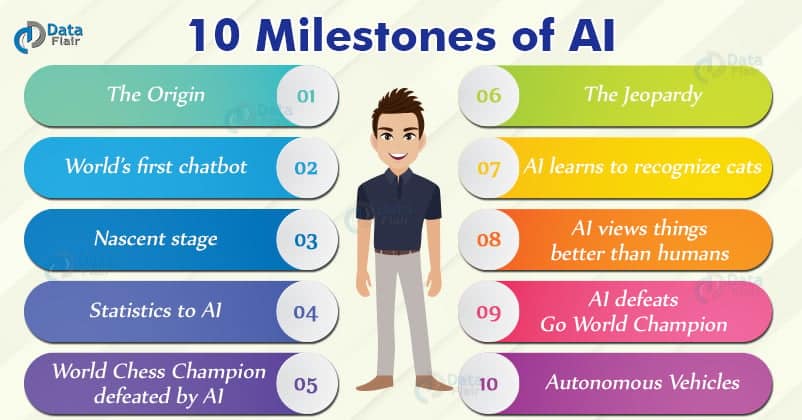
Looking back at the trajectory of Artificial Intelligence (AI) development, it is fascinating to see the remarkable milestones that have been achieved. From the game of chess to the groundbreaking development of self-driving cars, AI has emerged as a force to be reckoned with. This article takes you on a journey through the key milestones in AI development, showcasing the incredible advancements that have been made in this rapidly evolving field. So, fasten your seatbelt and prepare to be amazed by the incredible achievements of AI.
The Early Days of AI
The Birth of AI
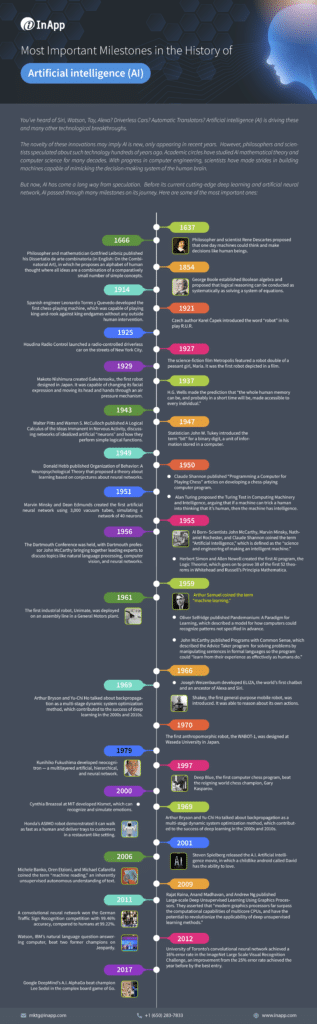
The field of Artificial Intelligence (AI) has come a long way since its inception. It all began in the 1950s when researchers sought to create computer systems that could mimic human intelligence. The term “Artificial Intelligence” was coined by John McCarthy, who organized a conference at Dartmouth College in 1956, where the groundwork for AI research was laid. This conference brought together leading scientists and mathematicians, sparking interest and conversation around the possibility of creating intelligent machines.
The Dartmouth Conference
The Dartmouth Conference played a pivotal role in shaping the early development of AI. McCarthy, along with other attendees, was optimistic about the potential of AI to solve complex problems and enhance human capabilities. During the conference, they formulated the concept of “thinking machines” and outlined the goals and challenges of AI research. This landmark event marked the beginning of a new era and set the stage for significant advancements in the field.
The Development of Chess-playing AI
Early Computer Chess Programs
Chess has long been at the forefront of AI research. In the 1950s and 1960s, researchers developed early computer chess programs that aimed to compete with human players. These programs utilized brute-force algorithms to analyze all possible moves and evaluate the best one. Although these early programs were relatively simple compared to modern AI, they laid the foundation for future developments in chess AI.
Deep Blue vs. Garry Kasparov
The historical match between Deep Blue, IBM’s supercomputer, and world chess champion Garry Kasparov in 1997 marked a significant milestone in AI development. Deep Blue utilized advanced algorithms and massive computational power to defeat Kasparov, becoming the first computer to defeat a reigning world chess champion in a six-game match. This victory demonstrated that AI had reached a level of sophistication where it could outperform even the most skilled human players, sparking further interest and investment in AI research.

Natural Language Processing Breakthroughs
The Turing Test
In 1950, renowned mathematician Alan Turing proposed a test to determine if a machine can exhibit intelligence indistinguishable from that of a human. This test, known as the Turing Test, involves a human evaluator interacting with a machine and a human through a text-based conversation. If the evaluator cannot consistently distinguish between the machine and the human, then the machine is said to have passed the test. While the Turing Test remains a controversial benchmark, it has played a crucial role in advancing natural language processing and pushing the boundaries of AI capabilities.
IBM’s Watson
IBM’s Watson, a question-answering computer system, made waves in 2011 when it competed and won against human contestants on the quiz show Jeopardy!. Watson demonstrated the ability to understand natural language, process massive amounts of data, and accurately answer complex questions in real-time. This breakthrough showcased the progress made in natural language processing and opened up new possibilities for AI applications in various industries, including healthcare, finance, and customer service.
Machine Learning and Neural Networks
The Perceptron Algorithm
In the late 1950s, psychologist Frank Rosenblatt developed the perceptron, an algorithm inspired by the human brain’s neural networks. The perceptron, a type of artificial neural network, was capable of learning from input data and making predictions. While limited in its capabilities, the perceptron marked an important step towards creating more advanced machine learning algorithms.
Backpropagation
In the 1980s, the development of the backpropagation algorithm revolutionized neural networks and machine learning. Backpropagation allowed neural networks to adjust their weights and biases based on the errors they made, resulting in improved performance and accuracy. This breakthrough made it possible to train neural networks with multiple hidden layers, leading to the development of deep learning networks capable of handling complex tasks.
Convolutional Neural Networks
Convolutional Neural Networks (CNNs) have been instrumental in advancing computer vision and image recognition. CNNs, inspired by the visual cortex of animals, utilize specialized layers to extract features from images and classify objects. These networks have been widely used in diverse applications, from facial recognition software to self-driving cars, and have significantly improved the accuracy and efficiency of AI systems in understanding visual information.

The Renaissance of AI
The Rise of Big Data
The availability of massive amounts of data, coupled with advances in computing power, has fueled the resurgence of AI. Big Data plays a crucial role in training AI algorithms and enabling systems to learn from vast quantities of information. With more data being generated than ever before, AI systems can draw insights, make predictions, and provide personalized experiences across various industries.
Internet of Things (IoT)
The emergence of the Internet of Things (IoT) has further expanded the AI landscape. IoT devices, such as smart sensors and connected devices, generate a plethora of data that can be harnessed by AI systems. This interconnectedness allows AI to optimize processes, automate tasks, and improve efficiency in various domains, ranging from smart homes to industrial settings.
Reinforcement Learning
Reinforcement Learning has garnered attention as a powerful technique in training AI systems. This approach involves training an AI agent through trial and error, with rewards and penalties guiding its learning process. Reinforcement Learning has led to notable achievements in gaming, robotics, and autonomous systems, where AI agents can learn complex behaviors and make optimal decisions in dynamic environments.
AI’s Impact on Healthcare
Detecting Cancer and Diseases
AI has the potential to revolutionize healthcare by improving disease detection and diagnosis. Machine learning algorithms can analyze medical images, such as X-rays and MRI scans, to detect abnormalities and assist radiologists in making accurate diagnoses. AI systems can also process vast amounts of patient data, identifying patterns that help physicians detect early signs of diseases like cancer, providing prompt and potentially life-saving interventions.
Drug Discovery and Development
The process of discovering and developing new drugs can be time-consuming and costly. AI is poised to transform this field by accelerating drug discovery and optimization. Machine learning models can sift through vast databases of chemical compounds, predicting their properties and identifying potential candidates for further development. Additionally, AI algorithms can simulate the effects of drugs on biological systems, helping researchers understand drug interactions and optimize treatment plans.
AI in Finance and Stock Trading
High-Frequency Trading
AI has had a profound impact on the financial industry, particularly in the realm of high-frequency trading (HFT). HFT algorithms leverage AI and advanced statistical techniques to analyze market data and execute trades at incredibly fast speeds. These algorithms can process vast amounts of financial data, detect patterns, and make split-second trading decisions, aiming to capitalize on minor price fluctuations. HFT has transformed the landscape of stock trading, introducing speed and efficiency to markets worldwide.
Algorithmic Trading
In addition to HFT, AI has enabled the rise of algorithmic trading, which uses pre-defined rules to automate trading strategies. These algorithms can analyze market conditions, historical data, and news events to make informed trading decisions. Algorithmic trading has improved market liquidity, reduced transaction costs, and provided investors with new opportunities to maximize returns. It has become an integral part of the financial industry, shaping the way trades are executed in global markets.
AI in Natural Language Processing
Chatbots and Virtual Assistants
The breakthroughs in natural language processing have made it possible to develop chatbots and virtual assistants capable of holding conversations with users. These AI-powered conversational agents can understand and respond to human queries, providing information, completing tasks, and even engaging in casual conversations. Chatbots and virtual assistants have found applications in customer support, social media, and other domains, enhancing user experiences and streamlining interactions.
Translation Services
AI has also revolutionized the field of translation, making it easier for people to communicate across different languages. Machine Learning models, such as Neural Machine Translation (NMT), have drastically improved the accuracy and fluency of automated translation services. These systems can understand the nuances of different languages and provide more accurate translations, benefiting individuals, businesses, and organizations operating in multilingual environments.

AI in Robotics and Automation
Self-driving Cars
Self-driving cars represent a groundbreaking application of AI in the field of robotics and automation. Machine Learning algorithms enable these vehicles to perceive their environment through sensors, process real-time data, and make decisions to navigate roads safely. Companies like Tesla, Waymo, and Uber have invested heavily in self-driving car technology, aiming to improve road safety, enhance transportation logistics, and reduce emissions. Self-driving cars hold the potential to revolutionize the entire transportation industry.
Industrial Automation
AI has transformed the manufacturing sector through industrial automation. Robots equipped with AI algorithms can perform repetitive tasks with precision, speed, and efficiency. These robots can execute complex assembly processes, inspect products for quality control, and adapt to changing production requirements. Industrial automation powered by AI has increased productivity, reduced errors, and improved worker safety, leading to significant advancements in the manufacturing industry.
Ethical Considerations in AI
Privacy and Data Protection
As AI systems become increasingly integrated into our lives, concerns about privacy and data protection arise. AI algorithms rely on vast amounts of personal data to operate effectively. Safeguarding this data and ensuring its responsible use is crucial. Striking a balance between AI’s benefits and individuals’ right to privacy requires robust data protection regulations and ethical considerations throughout AI development and deployment.
Bias and Fairness
AI systems are heavily reliant on the data they are trained on, and this data can contain inherent biases. If not properly addressed, these biases can perpetuate discrimination and inequality. Striving for fairness and eliminating biases in AI algorithms is essential to ensure that AI systems treat all individuals fairly and do not perpetuate unjust societal norms. Ongoing research, transparency, and diverse datasets are essential in addressing bias and forging a path towards fair AI.
Human Workforce Displacement
The rapid advancement of AI and automation raises concerns about the potential displacement of human workers in various industries. While AI has the potential to automate certain tasks, it also opens up new opportunities for human workers. Transitioning to an AI-enabled future requires proactive measures to reskill and upskill the workforce, creating new job roles that work in tandem with AI systems. Collaboration between humans and AI can lead to enhanced productivity, efficiency, and innovation.
In conclusion, the journey of AI development has been marked by significant milestones across various domains. From the early days of AI at the Dartmouth Conference to the advancements in chess-playing AI and natural language processing, the field has evolved exponentially. Machine learning and neural networks have fueled progress, leading to breakthroughs in healthcare, finance, natural language processing, and robotics. As AI’s impact grows, addressing ethical considerations becomes crucial to ensure responsible and fair AI deployment. The future of AI holds immense potential to tackle complex challenges and improve lives, ushering in a new era of innovation and transformation.