In this article, we explore the revolutionary impact of artificial intelligence (AI) on the field of mental health. With an increasing understanding of the complexities of mental illnesses, AI has emerged as a transformative tool in the diagnosis and treatment of such conditions. By analyzing vast amounts of data and patterns, AI can assist healthcare professionals in making accurate diagnoses, developing personalized treatment plans, and even predicting potential relapses. Discover how AI is revolutionizing the landscape of mental health, offering new hope and possibilities for individuals seeking support and treatment.
Understanding AI in Mental Health
AI, or Artificial Intelligence, is a branch of computer science that focuses on the development of intelligent machines capable of performing tasks that would otherwise require human intelligence. In recent years, AI has been revolutionizing various industries, and mental health is no exception. This technology has the potential to transform the field of mental health by improving diagnosis, treatment approaches, and overall patient care.
Definition of AI
Artificial Intelligence refers to the simulation of human intelligence in machines that are programmed to think, learn, and problem-solve like humans. It encompasses various techniques such as machine learning, natural language processing, and expert systems. These technologies allow AI systems to analyze vast amounts of data, recognize patterns, and make informed decisions, all without explicit human programming.
Applications of AI in Mental Health
The applications of AI in mental health are vast and diverse. It can be utilized to aid in diagnosis, treatment planning, therapy delivery, and even early detection and prevention of mental health disorders. By leveraging the power of AI, mental health professionals can enhance the efficiency and accuracy of their practice, reduce costs, and make mental health services more accessible to a wider population.
AI in Mental Health Diagnosis
One of the most promising applications of AI in mental health is in diagnosis. AI-based systems can analyze a multitude of data, including medical records, symptoms, genetic information, and even social media activity to assist in the accurate diagnosis of mental health disorders. By using complex algorithms and machine learning techniques, AI systems can identify patterns and risk factors that may not be apparent to human clinicians.
Advantages of AI in diagnosis
The use of AI in mental health diagnosis offers several advantages. Firstly, it can provide more objective and unbiased assessments by removing human subjectivity and errors. AI systems can analyze large volumes of data consistently and identify subtle patterns that clinicians may overlook. Additionally, AI can process information quickly, leading to faster diagnosis and treatment initiation. This is especially crucial in cases where early intervention can make a significant difference in patient outcomes.
Challenges of AI in diagnosis
Despite its promise, AI in mental health diagnosis presents some challenges. One major concern is the lack of transparency in AI algorithms. These systems operate based on complex models that can be difficult to understand for human users. Lack of transparency raises ethical concerns, such as the inability to explain how a diagnosis was reached, which could hinder trust and acceptance by mental health professionals and patients.
Current AI-based diagnosis systems
Several AI-based diagnosis systems have emerged in recent years. For example, the World Health Organization (WHO) has developed the Mental Health Gap Action Programme (mhGAP) Intervention Guide, which utilizes AI algorithms to assist non-specialist healthcare providers in making accurate mental health diagnoses. Another system, developed by researchers at Stanford University, uses machine learning to analyze speech patterns and detect depression in individuals.
Impact of AI on Treatment Approaches
AI is not limited to diagnosis; it also has a significant impact on treatment approaches in mental health. By integrating AI into clinical practice, mental health professionals can create personalized treatment plans, improve therapy delivery, and implement AI-assisted interventions.
Personalized treatment plans
Every individual’s mental health needs are unique, and AI can help tailor treatment plans accordingly. By analyzing patient data, such as medical history, symptoms, and responses to previous treatments, AI systems can generate personalized recommendations for therapies, medications, and lifestyle modifications. This approach maximizes the chances of successful treatment outcomes and reduces the trial-and-error process often encountered in mental health care.
Improved therapy delivery
AI can enhance therapy delivery by providing real-time monitoring and feedback to patients. For instance, virtual therapy platforms equipped with AI algorithms can analyze speech patterns, facial expressions, and physiological signals to gauge a patient’s emotional state and provide appropriate interventions. This not only increases the efficiency of therapy but also allows for remote access to mental health services, making them more accessible for individuals who face barriers to in-person treatment.
AI-assisted interventions
In addition to personalized treatment plans and improved therapy delivery, AI can also assist in the development of interventions. For example, AI algorithms can analyze data from wearable devices, such as smartwatches, to detect early signs of mental health deterioration. This enables timely interventions and preventive measures, reducing the risk of relapse or escalation of symptoms.
Ethical Considerations of AI in Mental Health
While the potential of AI in mental health is tremendous, it also raises various ethical considerations that need to be addressed. Three key areas of concern are data privacy and security, bias and fairness, and human supervision and responsibility.
Data privacy and security
AI systems rely on large amounts of data to function effectively. However, this raises concerns about data privacy and security. Mental health data is highly sensitive and must be protected to maintain patient confidentiality. Additionally, the potential for data breaches or unauthorized access to personal information poses significant risks.
Bias and fairness
AI algorithms can inadvertently perpetuate biases present in the data they are trained on, leading to unfair outcomes. For example, if an AI system is trained on a predominantly male population, it may not accurately assess mental health symptoms in females. Ensuring fairness in AI systems is crucial to avoid exacerbating existing disparities in mental health care.
Human supervision and responsibility
While AI can be highly accurate and efficient, it should not replace human clinicians. Human supervision is necessary to ensure the ethical use of AI in mental health. Mental health professionals have the expertise to interpret AI-generated results, consider contextual factors, and make informed decisions. Ultimately, the responsibility for patient care and well-being lies with human clinicians, with AI serving as a valuable tool to support their practice.

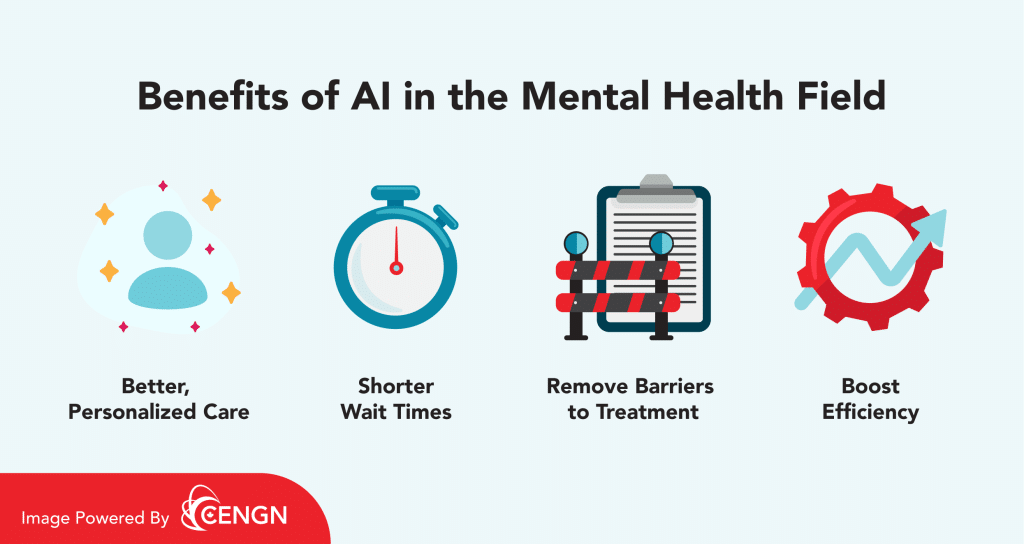
Benefits of AI in Mental Health
The integration of AI in mental health brings numerous benefits that can revolutionize the field.
Enhanced efficiency and accuracy
AI systems can process and analyze vast amounts of data quickly and accurately, leading to more efficient and accurate diagnoses and treatment plans. This saves time for mental health professionals, allowing them to focus on providing quality care and reducing the burden of administrative tasks.
Reduced costs and accessibility
By automating some aspects of mental health care, AI can reduce costs for both patients and healthcare systems. Virtual therapy platforms can provide remote access to care, eliminating the need for in-person visits and reducing associated costs, such as travel expenses. This increases the accessibility of mental health services, particularly for individuals in rural areas or those with limited mobility.
Early detection and prevention
AI’s ability to analyze diverse data sources, such as social media activity or voice patterns, allows for early detection of mental health issues. By identifying early warning signs and risk factors, interventions can be initiated promptly, potentially preventing the development or worsening of mental health disorders. This proactive approach can significantly improve patient outcomes and reduce the burden on healthcare systems.
Limitations of AI in Mental Health
While the potential benefits of AI in mental health are significant, there are also limitations that need to be considered.
Lack of emotional understanding
One key limitation of AI is its lack of emotional understanding. Mental health disorders often involve complex emotional experiences that may be challenging for AI systems to fully comprehend. Emotional nuances, such as sarcasm or tone of voice, may not be accurately interpreted, potentially influencing the accuracy of assessments or interventions.
Reliance on data quality and availability
The effectiveness of AI algorithms depends heavily on the quality and availability of data. If the data used to train AI systems is incomplete, biased, or outdated, it may lead to inaccurate assessments or recommendations. Similarly, data from specific populations may be scarce, resulting in limited representation and potential disparities in the performance of AI systems across different groups.
Limited human interaction
AI cannot fully replace human interaction in mental health care. While virtual therapy platforms and AI-assisted interventions are valuable resources, they cannot replace the empathy, emotional connection, and therapeutic alliance that comes from face-to-face interactions with mental health professionals. For some individuals, a human touch is essential for effective treatment and support.

Future Possibilities of AI in Mental Health
As AI continues to advance, the future possibilities in mental health are exciting.
Integration with wearable devices
Wearable devices, such as smartwatches or biosensors, provide real-time data on various physiological and behavioral markers. By integrating these devices with AI algorithms, mental health professionals can obtain continuous insights into a patient’s well-being, enabling personalized interventions and monitoring progress more effectively.
AI-driven virtual therapy platforms
Virtual therapy platforms are already making strides in increasing access to mental health services. With the advancement of AI, these platforms can become even more sophisticated. AI algorithms can analyze a patient’s speech, facial expressions, and other non-verbal cues to provide real-time feedback and guidance during therapy sessions, simulating the benefits of in-person interactions.
Predictive analytics and risk assessment
AI’s ability to analyze large datasets and identify patterns can greatly contribute to predictive analytics and risk assessment in mental health. By detecting early signs of deterioration or relapse, AI algorithms can support mental health professionals in implementing timely interventions and preventive measures, ultimately improving patient outcomes and reducing healthcare costs.
Collaboration between AI and Mental Health Professionals
To fully harness the potential of AI in mental health, collaboration between AI technologies and mental health professionals is crucial.
Complementary roles
AI should be seen as a complementary tool that supports mental health professionals rather than replacing them. While AI systems can process vast amounts of data and perform complex analyses, mental health professionals bring the contextual understanding, empathy, and expertise necessary for comprehensive patient care. By combining the strengths of AI with the skills of mental health professionals, the field can provide more effective and personalized care.
Building trust and acceptance
As AI becomes increasingly integrated into mental health care, building trust and acceptance among mental health professionals, patients, and the general public is paramount. Clear communication about the capabilities, limitations, and ethical considerations of AI is essential. Transparency in the development and deployment of AI systems, including robust governance and accountability mechanisms, can help address concerns and build confidence in the technology.
Training and expertise requirements
To ensure the responsible and effective use of AI in mental health, mental health professionals must be equipped with the necessary training and expertise. They should be familiar with AI technologies, understand their capabilities and limitations, and receive ongoing education to stay up-to-date with advancements in the field. Collaboration between AI developers and mental health professionals in training programs can bridge the gap and create synergistic partnerships.
Overcoming Challenges in Implementing AI in Mental Health
As with any emerging technology, implementing AI in mental health comes with its own challenges. However, these challenges can be addressed through legal and regulatory frameworks, ethical guidelines and standards, and addressing public concerns and skepticism.
Legal and regulatory frameworks
Clear legal and regulatory frameworks are needed to ensure the ethical use of AI in mental health. Laws must protect patient privacy, ensure secure data handling, and establish guidelines for the responsible use of AI systems. Regulatory bodies need to monitor the development and deployment of AI technologies, ensuring they meet safety and efficacy standards.
Ethical guidelines and standards
Ethical guidelines and standards provide a framework for the responsible use of AI in mental health. Organizations, such as professional associations and regulatory bodies, should develop guidelines that address issues such as data privacy, bias mitigation, and human supervision. Adherence to these guidelines can help foster trust and ensure ethical practices in the field.
Addressing public concerns and skepticism
Public concerns and skepticism towards AI in mental health need to be addressed through education and open dialogue. Addressing misconceptions and providing accurate information about the benefits and limitations of AI can help alleviate fears and build acceptance. Involving patients and the general public in the development and implementation of AI systems can also foster a sense of ownership and trust.
Conclusion
AI has the potential to revolutionize the field of mental health by improving diagnosis, treatment approaches, and overall patient care. The applications of AI in mental health are wide-ranging and diverse, from assisting in accurate diagnoses to personalizing treatment plans and implementing early interventions. While ethical considerations, limitations, and challenges exist, collaboration between AI technologies and mental health professionals can overcome these obstacles and create a future where AI plays a vital role in mental health care. By harnessing the power of AI responsibly and ethically, we can pave the way for a more accessible, efficient, and effective mental health system.