Language barriers have long been a challenge for global communication and understanding, but thanks to the advancements in Artificial Intelligence (AI), these barriers are starting to crumble. AI and language translation have become an inseparable duo, revolutionizing how we communicate across different languages. With AI-powered translation tools becoming more advanced and accurate, it is now easier than ever to bridge the gap between languages, connecting people from all around the world. Whether it’s for business, travel, or simple everyday conversations, AI is breaking down language barriers and ushering in a new era of seamless multilingual communication.

Introduction
Language is a powerful tool that allows us to communicate our thoughts, ideas, and emotions. However, the diversity of languages around the world can often act as a barrier to effective communication. This is where language translation plays a crucial role. Language translation involves the conversion of written or spoken text from one language to another, enabling individuals to bridge the gap and communicate across linguistic boundaries. In recent years, the advancement of artificial intelligence (AI) has revolutionized language translation, making it faster, more accurate, and easily accessible to people all over the world. In this article, we will explore the importance of language translation, the challenges it poses, the role of AI in translation, the benefits it offers, ethical considerations, and various applications of AI language translation.
Why Language Translation is Important
Expanding Global Communication
Language translation serves as a key facilitator of global communication. While there are nearly 7,000 languages spoken worldwide, a handful of languages such as English, Spanish, Mandarin, and French dominate the global stage. Translation allows individuals who do not speak these dominant languages to access information, participate in international discussions, and connect with people from diverse linguistic backgrounds. By breaking down language barriers, translation promotes inclusivity and fosters a more connected global community.
Enhancing Cross-Cultural Understanding
Language translation plays a crucial role in enhancing cross-cultural understanding. It enables individuals to access literature, articles, and documents from different cultures, exposing them to new perspectives and ideas. Translating works of literature, for example, allows readers to explore the beauty and depth of different cultures and fosters empathy and mutual understanding. Additionally, translation facilitates the sharing of knowledge and academic research, promoting collaboration between scholars from various parts of the world.
Facilitating International Business
In today’s globalized economy, language translation is essential for smooth international business operations. It enables companies to communicate with partners, clients, and customers across different countries and language barriers. Translation ensures that marketing materials, contracts, and business documents are accurately conveyed, avoiding any misunderstandings or misinterpretations. By breaking down language barriers, translation helps businesses expand their reach, tap into new markets, and build strong relationships with customers globally.
Enabling Travel and Tourism
Language translation is invaluable when it comes to travel and tourism. It allows tourists to communicate with locals, navigate unfamiliar surroundings, and understand important information such as directions, safety instructions, and cultural norms. Translation services in airports, hotels, and popular tourist destinations help create a seamless and enjoyable travel experience. By enabling effective communication, translation enhances cultural exchange and promotes a deeper appreciation for diverse cultures and traditions.

Challenges in Language Translation
While language translation serves as a vital communication tool, it also poses several challenges. These challenges require careful consideration and problem-solving to ensure accurate and meaningful translations.
Semantic Ambiguity
One of the significant challenges in language translation is semantic ambiguity. Words or phrases in one language may have multiple meanings or nuanced interpretations. Translators need to navigate these complexities to accurately convey the intended message. Context, cultural connotations, and subject matter play crucial roles in overcoming semantic ambiguity.
Cultural Nuances
Effective translation goes beyond converting words from one language to another; it requires a deep understanding of cultural nuances. Different cultures have unique ways of expressing ideas, emotions, and concepts. Translators must be sensitive to these cultural nuances to ensure translations resonate with the target audience and maintain the intended meaning. Failing to account for cultural differences may lead to misunderstandings or render the translation ineffective.
Idiomatic Phrases
Translating idiomatic phrases is often challenging. Idioms are expressions specific to a language or culture that do not directly translate word by word. Translators must find equivalent idiomatic expressions in the target language to convey the intended meaning. This requires creativity and a deep understanding of both languages involved to capture the essence of the original phrase.
Regional Dialects
Languages often have regional dialects that vary in vocabulary, grammar, and pronunciation. Translating a text from one dialect to another can pose challenges as words or phrases may have different meanings or nuances. Translators must be well-versed in the dialects of both the source and target languages to ensure accurate and culturally appropriate translations.
The Role of AI in Language Translation
The advent of artificial intelligence (AI) has revolutionized the field of language translation. AI-powered translation systems leverage advanced algorithms, machine learning, and natural language processing to enhance translation accuracy, efficiency, and accessibility.

Natural Language Processing (NLP)
Natural Language Processing (NLP) is a branch of AI that focuses on the interaction between computers and human language. NLP algorithms allow computers to understand, interpret, and generate human language in a way that is meaningful and contextually accurate. In the context of language translation, NLP enables AI systems to analyze the syntax, grammar, and semantics of a source language and generate a corresponding translation in the target language.
Understanding Syntax and Semantics
NLP algorithms are trained to understand the syntax and semantics of different languages. They can analyze sentence structure, identify parts of speech, and determine the relationships between words and phrases. By understanding the grammatical and syntactical rules of a language, AI systems can generate more accurate and coherent translations.
Machine Learning for Language Translation
Machine learning plays a vital role in AI language translation. Machine learning algorithms are trained on vast amounts of bilingual content to develop language models that can accurately translate between languages. These algorithms learn by identifying patterns, trends, and relationships within the data and using that knowledge to make predictions and generate translations. As more data becomes available, machine learning models continually improve their translation capabilities.
Machine Translation Techniques
AI language translation employs various machine translation techniques that have evolved over time. These techniques include rule-based machine translation, statistical machine translation, and neural machine translation.
Rule-based Machine Translation
Rule-based machine translation relies on predefined grammar and syntax rules to generate translations. Linguists and experts manually create these rules, defining how words and phrases in the source language should be translated into the target language. While rule-based translation can produce accurate translations, it often struggles with linguistic nuances and exceptions to grammar rules.
Statistical Machine Translation
Statistical machine translation uses statistical models and algorithms to generate translations. These models analyze vast amounts of bilingual texts and identify patterns and correlations between words and phrases in different languages. Statistical machine translation is data-driven and improves its accuracy as it continuously trains on more bilingual data.
Neural Machine Translation
Neural machine translation (NMT) is a state-of-the-art machine translation technique that leverages deep learning neural networks. NMT models learn to translate by processing large amounts of bilingual data and learning the complex relationships between words and phrases. Unlike rule-based or statistical machine translation, NMT models can capture the context and produce more natural-sounding translations. NMT has significantly advanced translation accuracy and fluency.

The Benefits of AI in Language Translation
As AI continues to revolutionize language translation, it offers numerous benefits over traditional translation methods.
Improved Accuracy and Efficiency
AI-powered translation systems excel in accuracy and efficiency. By learning from vast amounts of bilingual data, AI models can produce highly precise translations, reducing errors and misunderstandings. AI also improves translation efficiency by automating processes and significantly reducing the time required for translations.
Real-Time Translation
AI language translation has made real-time translations possible. With advancements in speech recognition and NLP, AI systems can now instantly convert spoken language into written translations. Real-time translation has proven invaluable in scenarios like international conferences, meetings, and travel, enabling seamless multilingual communication.
Multilingual Chatbots and Customer Support
AI-driven chatbots and customer support systems are increasingly being used to provide multilingual assistance. These AI-powered systems can understand and respond to customer queries in various languages, enhancing customer experience and satisfaction. Chatbots equipped with language translation capabilities enable businesses to provide round-the-clock support to customers in different parts of the world.
Language Translation Applications
AI language translation has paved the way for various applications across numerous industries. Language translation applications have become widely available, allowing users to translate documents, websites, and conversations with ease. These applications are empowering individuals to break down language barriers, fostering global communication and connectivity.
Ethical Considerations in AI Language Translation
While AI language translation offers numerous advantages, it also raises important ethical considerations that need careful attention.
Preserving Cultural Identity
Language is deeply intertwined with culture and traditions. When translating texts or conversations, it is crucial to preserve the cultural identity and nuances of the source language. AI systems should be designed with cultural sensitivity in mind, ensuring that translated content maintains its original meaning and cultural references.
Privacy and Security Concerns
AI language translation often involves the processing and analysis of personal data. It is essential to address privacy and security concerns to protect sensitive information. AI systems should adhere to strict data protection regulations, ensure secure data handling, and provide transparency on how user data is collected and utilized.
Potential Bias and Discrimination
AI language translation models can inadvertently perpetuate biases and discriminatory practices. These biases may arise from imbalanced training data or implicit biases embedded in the source data. To mitigate bias and discrimination, AI models need to be trained on diverse and representative data, and regular evaluation should be conducted to identify and rectify any biases that emerge.
Applications of AI Language Translation
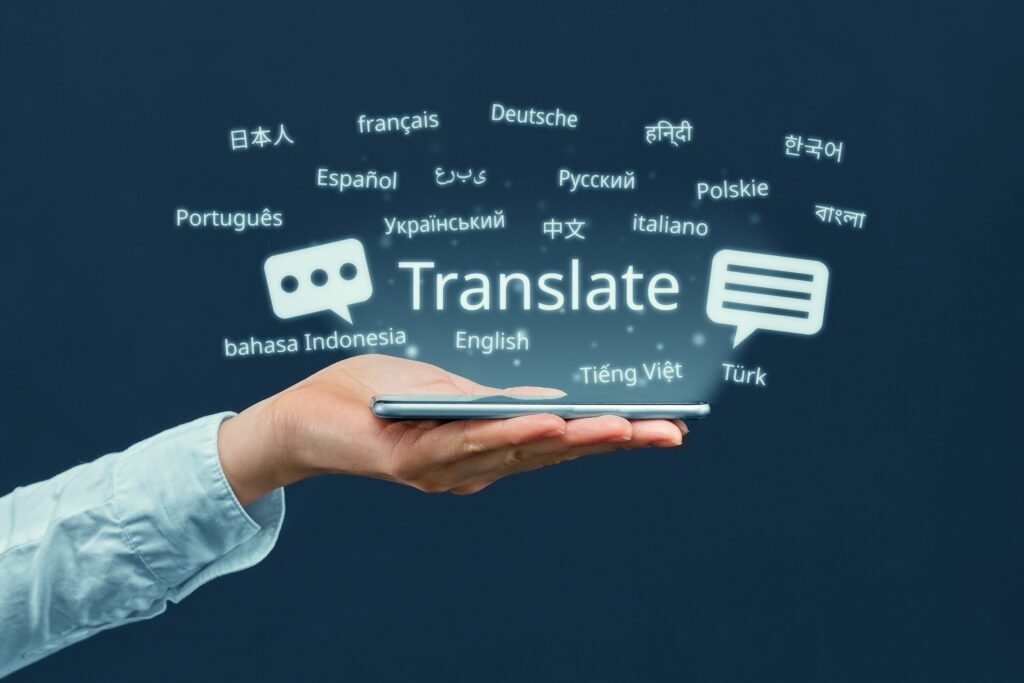
AI language translation finds applications in various fields and industries, both online and offline.
Online Language Translation Tools
Online language translation tools have become increasingly popular, enabling users to translate websites, documents, and text in real-time. These tools facilitate cross-border communication, enabling individuals to access information in different languages and interact with people from diverse linguistic backgrounds.
Language Learning Platforms
AI-powered language learning platforms are transforming the way people acquire new languages. These platforms use AI-generated translations, voice recognition, and personalized learning algorithms to create interactive and immersive language learning experiences. AI language translation helps learners understand and practice new vocabulary, sentence structures, and idiomatic expressions more effectively.
International Conferences and Meetings
AI language translation has made international conferences and meetings more accessible and inclusive. Real-time translation systems can instantly translate speeches and presentations, allowing attendees to follow along in their preferred language. This enhances cross-cultural exchange and participation, breaking down language barriers in professional settings.
Localization in Software and Websites
AI language translation is instrumental in software and website localization. Localization involves adapting software applications, websites, and digital content to suit the specific cultural and linguistic preferences of target markets. AI-powered translation systems automate the localization process, providing accurate translations and ensuring that the user experience is culturally appropriate.
Future Outlook
The future of AI language translation holds immense promise, with several advancements and potential applications on the horizon.
Advancements in AI Language Translation
As AI technology continues to evolve, language translation will become even more accurate and efficient. Models will improve in understanding cultural nuances, idiomatic expressions, and regional dialects, further enhancing translation quality. Additionally, the integration of AI with other emerging technologies like natural language generation and speech recognition will lead to more seamless and natural-sounding translations.
Integration of AI in Smart Devices
AI language translation is expected to be integrated into a variety of smart devices, such as smartphones, smart speakers, and wearables. This integration will enable users to communicate effortlessly across languages and interact with their devices in their preferred language. The widespread adoption of AI language translation in smart devices will bring language translation capabilities to the fingertips of millions worldwide.
Potential Impact on Interpersonal Communication
As AI language translation becomes more sophisticated and widely accessible, it has the potential to revolutionize interpersonal communication. Language barriers will no longer be a hindrance in building relationships, discussing ideas, or navigating new cultural experiences. AI language translation may bridge the gap between languages and cultures, fostering greater understanding and empathy among individuals.
In conclusion, AI language translation has transformed the way we communicate and connect across linguistic barriers. It plays a crucial role in expanding global communication, enhancing cross-cultural understanding, facilitating international business, and enabling travel and tourism. Despite the challenges it poses, AI has significantly improved translation accuracy, efficiency, and accessibility. With advancements in AI technology and its integration into various applications, the future of language translation looks promising. As we embrace AI advancements responsibly, we can look forward to a more connected and inclusive world, where language is no longer a barrier but a bridge to understanding and collaboration.