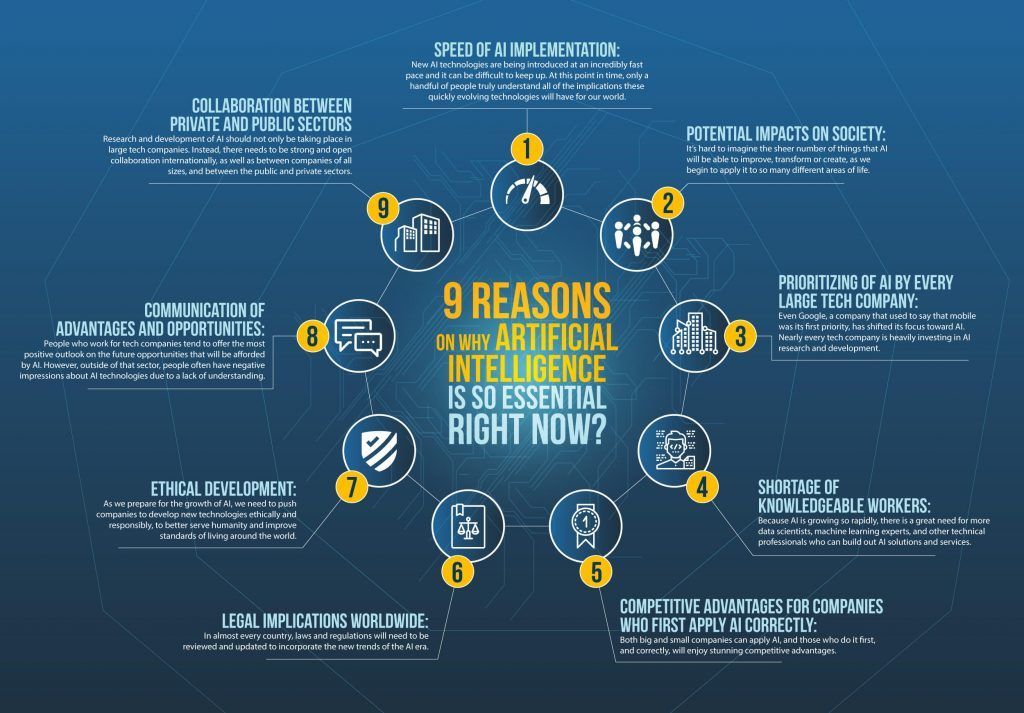
Artificial intelligence is revolutionizing the way we live and interact with technology. From voice assistants on our smartphones to self-driving cars, AI has become an integral part of our daily lives. But what exactly is the importance of AI to humanity? In this article, we will explore the incredible possibilities that AI brings to various industries, the benefits it offers in healthcare and education, and the ethical considerations surrounding its development and use. Get ready to discover how AI is shaping our world and changing the way we live.

Enhancing Efficiency and Productivity
Automation of Repetitive Tasks
Artificial Intelligence (AI) plays a crucial role in enhancing efficiency and productivity in various industries. One significant way it achieves this is through the automation of repetitive tasks. Mundane, time-consuming activities can be completed much faster and with fewer errors when performed by AI-powered systems. For example, in manufacturing plants, robots equipped with AI algorithms can assemble products on assembly lines at a much higher speed and accuracy than human workers. This not only reduces costs for businesses but also allows employees to focus on more complex and creative tasks that require human intelligence.
Predictive Analytics
Predictive analytics is another area in which AI excels. By analyzing large amounts of data and identifying patterns, AI systems can make accurate predictions, helping businesses make informed decisions and optimize their operations. For instance, in the financial sector, AI algorithms can analyze stock market trends and historical data to make predictions about future market movements. This enables investors to make well-informed investment decisions, ultimately increasing their chances of success. Predictive analytics powered by AI can be applied to various domains, such as healthcare, marketing, sales, and supply chain management, resulting in improved efficiency and productivity.
Streamlining Workflow
AI technologies are also capable of streamlining workflows by automating and optimizing processes. For example, in customer support centers, AI-powered chatbots can handle routine customer inquiries and provide instant responses, freeing up human agents to handle more complex issues. This not only improves efficiency but also enhances the overall customer experience. Additionally, AI algorithms can analyze workflow data to identify bottlenecks and optimize processes to reduce delays and increase productivity. By streamlining workflow, AI helps businesses operate more efficiently, saving time and resources.
Optimizing Resource Allocation
AI has the ability to optimize resource allocation, leading to improved efficiency and productivity. By analyzing data and making intelligent decisions, AI systems can allocate resources such as manpower, machinery, and materials more effectively. In logistics and supply chain management, AI algorithms can analyze real-time data, including traffic conditions and inventory levels, to determine the most efficient routes for delivery trucks and the optimal distribution of goods. This ensures that resources are utilized in the most cost-effective way, minimizing wastage and maximizing productivity. Through optimized resource allocation, AI contributes to the overall efficiency and profitability of businesses.
Improving Healthcare
Early Disease Detection
The healthcare industry greatly benefits from AI in terms of early disease detection. AI systems can analyze vast amounts of patient data, including medical records, genetic information, and lifestyle factors, to identify patterns and identify individuals at risk of developing certain diseases. For example, AI algorithms can analyze medical images such as X-rays and MRIs to detect early signs of cancer or other abnormalities that may go unnoticed by human radiologists. This early detection allows for timely interventions and treatments, potentially saving lives and improving patient outcomes.
Personalized Medicine
Another way AI improves healthcare is through personalized medicine. By leveraging AI algorithms, healthcare professionals can analyze individual patient data and develop personalized treatment plans tailored to each patient’s unique needs. This approach takes into account factors such as genetic variations, medical history, and lifestyle choices to determine the most effective treatments. For example, AI can analyze genomic data to identify specific mutations that may influence drug responses, enabling doctors to prescribe medications that are more likely to be effective and reduce the risk of adverse reactions. Personalized medicine empowered by AI has the potential to revolutionize healthcare by providing tailored treatments that yield better patient outcomes.
Medical Research and Drug Discovery
AI has also revolutionized medical research and drug discovery. Traditional drug discovery processes are often time-consuming and costly, requiring extensive trial-and-error experimentation. However, AI algorithms can analyze vast amounts of biological and chemical data to identify potential drug targets and predict the effectiveness of various compounds. This accelerates the drug discovery process, reducing costs and the time it takes to bring new drugs to market. Additionally, AI can analyze scientific literature and clinical trial data to identify patterns and generate new insights, facilitating further medical research and advancements. AI-driven medical research and drug discovery have the potential to yield breakthrough treatments and significantly improve healthcare outcomes.
Remote Patient Monitoring
AI technologies enable remote patient monitoring, which is particularly beneficial for individuals with chronic conditions and the elderly. By utilizing devices equipped with sensors and AI algorithms, healthcare providers can continuously monitor vital signs, medication adherence, and other relevant data remotely. This allows doctors to detect and respond to any concerning changes promptly, avoiding potential complications and reducing the need for frequent hospital visits. Remote patient monitoring not only enhances patient care but also reduces healthcare costs by preventing unnecessary hospitalizations. AI-powered remote patient monitoring has the potential to revolutionize healthcare delivery, making it more accessible and efficient.

Enhancing Education
Personalized Learning Experience
AI has the potential to transform education by providing personalized learning experiences tailored to the needs and abilities of individual students. By analyzing student data, such as their learning preferences, strengths, and weaknesses, AI algorithms can create customized learning paths and deliver personalized content. This ensures that students receive targeted instruction that meets their specific needs, leading to increased engagement and better learning outcomes. With AI-powered personalized learning, students can progress at their own pace and receive the support they need, improving their overall educational experiences.
Adaptive Learning Platforms
Adaptive learning platforms powered by AI are revolutionizing education by dynamically adjusting instructional materials and methods based on individual student progress. These platforms continuously analyze student performance, gather real-time feedback, and provide adaptive recommendations and interventions. For example, if a student is struggling with a particular concept, the AI system can provide additional resources or offer alternative explanations to facilitate better understanding. By adapting to each student’s learning needs, AI-powered platforms optimize learning outcomes and promote student success.
Smart Content Creation
AI technologies are also being used to create smart content that enhances the educational experience. AI-powered content creation tools can generate interactive and engaging educational materials, such as videos, simulations, and quizzes. These materials can adapt to the learner’s progress and provide targeted feedback, promoting active learning and knowledge retention. AI-generated content can cater to different learning styles and preferences, making learning more accessible and enjoyable for students. By leveraging AI for content creation, educators can provide high-quality, engaging resources that support effective learning.
Virtual Teachers and Tutors
AI-powered virtual teachers and tutors are emerging as valuable educational tools. These virtual assistants are designed to provide personalized instruction and support to students, similar to human teachers. They can respond to questions, explain concepts, and guide students through interactive lessons. Virtual teachers and tutors offer the advantage of 24/7 availability, allowing students to access learning support whenever they need it. Furthermore, AI-driven virtual assistants can track student progress, identify areas of weakness, and provide targeted feedback and recommendations for improvement. By complementing traditional teaching methods, virtual teachers and tutors powered by AI enhance the educational experience and promote academic success.
Revolutionizing Transportation
Autonomous Vehicles
One of the most notable advancements in transportation enabled by AI is the development of autonomous vehicles. AI algorithms and sensors allow vehicles to perceive and interpret their surroundings, make decisions, and navigate without human intervention. Autonomous vehicles have the potential to significantly improve road safety by reducing human error, which is a leading cause of accidents. Additionally, autonomous vehicles can optimize traffic flow and reduce congestion by communicating with each other and making collective decisions. The widespread adoption of autonomous vehicles has the potential to revolutionize transportation systems, making them safer, more efficient, and more sustainable.
Traffic Optimization
AI-powered traffic optimization systems are transforming the way traffic is managed in urban areas. By analyzing real-time data from various sources, including sensors, cameras, and GPS systems, AI algorithms can predict traffic congestion, identify bottlenecks, and propose optimal traffic management strategies. For example, traffic signals can be dynamically adjusted to synchronize with traffic flow and minimize delays. Additionally, AI can provide real-time routing recommendations to drivers, redirecting them to less congested routes and reducing overall travel time. By optimizing traffic, AI technologies enhance transportation efficiency, reduce carbon emissions, and improve the overall commuting experience.
Enhanced Safety Measures
AI technologies are being harnessed to enhance safety measures in transportation. Advanced driver assistance systems (ADAS) equipped with AI algorithms can monitor the environment, detect potential risks, and assist drivers in taking preventive actions. For instance, autonomous emergency braking systems can detect pedestrians or other obstacles on the road and automatically apply the brakes to avoid collisions. AI algorithms can also analyze driver behavior and detect signs of drowsiness or distraction, alerting the driver or initiating safety measures, such as lane departure warnings. By offering real-time support and intervention, AI contributes to improved safety on the roads, reducing the number of accidents and their associated human and economic costs.
Improved Logistics and Supply Chain
AI technologies have the potential to revolutionize logistics and supply chain management. AI algorithms can analyze real-time data on inventory levels, demand patterns, and transportation routes to optimize logistics operations. For example, AI can identify the most efficient routes for goods delivery, taking into account factors such as traffic conditions, weather, and cost. Furthermore, AI-powered supply chain management systems can use predictive analytics to forecast demand, optimize inventory levels, and minimize the risk of stockouts or excess inventory. By streamlining logistics and supply chain processes, AI enables faster and more efficient movement of goods, reducing costs and enhancing customer satisfaction.
Ensuring Cybersecurity
Threat Detection and Prevention
AI is playing a crucial role in cybersecurity by enabling advanced threat detection and prevention mechanisms. AI algorithms can analyze vast amounts of data and identify patterns and anomalies that may indicate cyber threats. By continuously monitoring network traffic, user behavior, and system logs, AI-powered systems can detect suspicious activities in real-time and respond promptly to mitigate potential risks. Additionally, AI-driven threat intelligence platforms can analyze global cybersecurity data to identify emerging threats and proactively protect systems and networks from new vulnerabilities. By augmenting human capabilities, AI enhances cybersecurity defenses and helps organizations stay ahead of cyber threats.
Advanced Authentication Systems
AI technologies are revolutionizing authentication systems, making them more secure and user-friendly. Traditional authentication methods, such as passwords and PINs, are prone to being compromised or forgotten. However, AI-powered biometric authentication systems offer a higher level of security and convenience. Facial recognition, fingerprint scanning, and voice recognition are examples of biometric authentication methods empowered by AI. These systems analyze unique biological or behavioral characteristics to verify identity and grant access. AI algorithms continuously learn and adapt to improve accuracy and prevent unauthorized access attempts. By utilizing advanced authentication systems, organizations can enhance cybersecurity and protect sensitive data from unauthorized access.
Data Privacy and Protection
AI plays a vital role in safeguarding data privacy and protection. As the volume of data being generated and processed increases, traditional data protection methods may become inadequate. AI-powered systems can automatically detect and classify sensitive data, ensuring that it is handled and protected in compliance with privacy regulations. Additionally, AI algorithms can identify potential vulnerabilities and recommend security measures to prevent data breaches and unauthorized access. By continuously monitoring and analyzing data, AI enhances data privacy and protection, giving individuals and organizations peace of mind that their information is secure.
Intelligent Intrusion Detection
AI-driven intrusion detection systems are crucial in identifying and mitigating cyber threats. These systems continuously monitor network activity and analyze patterns to detect unauthorized access attempts or malicious activities. By applying machine learning algorithms, AI systems can learn from historical data to identify new and previously unknown threats. This enables organizations to respond promptly and effectively to prevent or minimize the impact of cyber attacks. Intelligent intrusion detection empowers organizations to proactively protect their networks and systems, reducing the risk of data breaches or other cyber incidents.
Transforming Customer Experience
Chatbots and Virtual Assistants
Chatbots and virtual assistants are revolutionizing customer experience by providing instant assistance and support. Powered by AI technologies, chatbots can understand and respond to customer inquiries, enabling businesses to provide round-the-clock customer service. Chatbots can quickly provide answers to frequently asked questions, assist with product inquiries, or facilitate simple transactions. Virtual assistants powered by AI algorithms can even understand and respond to natural language queries, offering a more conversational and personalized experience. By automating customer interactions, chatbots and virtual assistants enhance customer satisfaction, reduce response times, and improve overall customer service.
Improved Customer Service
AI technologies improve customer service by enabling businesses to provide personalized and efficient support. AI algorithms can analyze customer data, such as purchase history and preferences, to anticipate customer needs and offer tailored recommendations or solutions. For example, e-commerce platforms can leverage AI to provide personalized product recommendations based on individual customer preferences and browsing behavior. Additionally, AI-powered customer service platforms can analyze customer sentiment and emotions in real-time to gauge satisfaction levels and identify potential issues. By leveraging AI to enhance customer service, businesses can build stronger customer relationships and foster loyalty.
Personalized Recommendations
AI-powered recommendation systems are transforming the way businesses personalize their offerings for customers. By analyzing customer data, including browsing behavior, purchase history, and demographic information, AI algorithms can make highly accurate product recommendations. These recommendations are tailored to each customer’s unique preferences, increasing the likelihood of customer satisfaction and conversion. AI recommendation systems are widely used in various industries, such as e-commerce, entertainment streaming platforms, and online advertising. By providing personalized recommendations, businesses can enhance the customer experience and drive revenue growth.
Enhanced User Interfaces
AI technologies are also enhancing user interfaces, making them more intuitive and user-friendly. AI algorithms can analyze user behavior and preferences to anticipate user needs and adapt the interface accordingly. For example, AI-powered websites can dynamically adjust the layout and content based on the user’s browsing history and preferences, offering a more personalized and relevant experience. Additionally, AI technologies such as natural language processing and computer vision enable more intuitive interactions, allowing users to interact with systems using voice commands or gestures. By enhancing user interfaces, AI improves usability, increases engagement, and enhances the overall customer experience.

Addressing Climate Change
Smart Energy Management
AI has the potential to play a crucial role in addressing climate change through smart energy management. AI algorithms can analyze real-time data on energy consumption, weather patterns, and renewable energy availability to optimize energy usage. For instance, AI can automatically adjust heating, ventilation, and air conditioning (HVAC) systems based on occupancy and outside temperature conditions, reducing energy waste. Furthermore, AI-powered demand response systems can incentivize consumers to shift their energy usage to off-peak hours, reducing strain on the grid and promoting energy efficiency. By optimizing energy management, AI contributes to the reduction of greenhouse gas emissions and the transition to a more sustainable energy future.
Environmental Monitoring
AI technologies are instrumental in environmental monitoring and conservation efforts. AI algorithms can analyze large amounts of data collected from satellites, sensors, and other sources to monitor and assess various environmental factors. For example, AI can analyze satellite imagery to detect deforestation patterns or track changes in land cover. Additionally, AI-powered systems can analyze real-time sensor data to monitor air and water quality, detect pollutant levels, and issue alerts in case of potential environmental hazards. By providing timely and accurate environmental data, AI enables proactive conservation measures and helps protect ecosystems and natural resources.
Optimized Agricultural Practices
AI is transforming agricultural practices by optimizing crop management and resource allocation. AI algorithms can analyze environmental data, such as weather conditions, soil quality, and pest infestations, to provide farmers with real-time insights and recommendations. For example, AI can recommend optimal irrigation schedules, fertilizer application rates, and pest control strategies, reducing resource waste and maximizing crop yields. Additionally, AI-powered agricultural robots and drones can perform tasks such as planting, monitoring crop health, and harvesting with high precision and efficiency. By optimizing agricultural practices, AI contributes to sustainable and efficient food production, reducing environmental impacts and ensuring food security.
Climate Prediction and Modeling
AI technologies play a critical role in climate prediction and modeling, enabling scientists to better understand and forecast changes in the climate system. AI algorithms can analyze vast amounts of climate data, including historical records, satellite observations, and climate models, to identify patterns and make accurate predictions. This allows researchers to project future climate scenarios, assess potential impacts, and inform policymaking and mitigation strategies. By leveraging AI for climate prediction and modeling, scientists can enhance our understanding of climate change and its potential consequences, guiding efforts to mitigate its effects and adapt to the changing environment.
Promoting Social Welfare
Assistive Technologies for the Disabled
AI has the potential to greatly improve the lives of individuals with disabilities through the development of assistive technologies. AI-powered systems can provide innovative solutions to enhance mobility, communication, and independence for individuals with physical or cognitive impairments. For example, AI-powered prosthetic limbs can offer greater functionality and natural movement, significantly improving the quality of life for amputees. Additionally, AI-based technologies can facilitate communication for individuals with speech or hearing impairments, enabling them to interact with others effectively. By leveraging AI for assistive technologies, society can promote inclusivity and empower individuals with disabilities to lead fulfilling lives.
Improved Accessibility
AI technologies contribute to improved accessibility by making digital content more inclusive and accessible to individuals with disabilities. AI algorithms can automatically generate closed captions for videos, making them accessible to individuals with hearing impairments. Additionally, AI-powered screen readers can assist individuals with visual impairments by converting text content into audio or braille formats. AI technologies can also help individuals with cognitive disabilities by providing personalized support, such as highlighting key information and simplifying complex content. By ensuring accessibility in digital platforms, AI promotes equal participation and inclusion for individuals with disabilities.
Social Care Support
AI technologies are being used to provide social care support to vulnerable populations, such as the elderly and individuals with chronic illnesses. AI-powered systems can monitor and analyze data from wearable devices, smart home sensors, and other sources to detect changes in daily routines, health indicators, or emergencies. This enables timely intervention and support, ensuring the well-being and safety of individuals living alone or with limited support. Additionally, AI-based virtual companions can offer emotional support and engage individuals in meaningful activities, reducing loneliness and social isolation. AI-powered social care support enhances the overall quality of life for vulnerable populations, promoting their well-being and independence.
Crisis Response and Disaster Management
AI technologies play a crucial role in crisis response and disaster management. During emergencies, AI-powered systems can analyze real-time data, such as social media posts, satellite imagery, and weather patterns, to provide accurate and timely information to responders and affected populations. AI-powered chatbots or virtual assistants can provide emergency support, answer frequently asked questions, and offer guidance. Additionally, AI algorithms can analyze historical data and predict the potential impact of natural disasters, facilitating better planning and preparedness measures. By leveraging AI for crisis response and disaster management, authorities can improve response times, mitigate risks, and save lives.
Understanding Human Behavior
Sentiment Analysis
AI technologies enable sentiment analysis, which is the process of analyzing language to determine the sentiment or emotion behind it. By analyzing text data from social media posts, customer reviews, or surveys, AI algorithms can identify sentiment patterns and gauge public opinion on specific topics or products. This information is valuable for businesses to understand customer preferences, identify areas for improvement, and tailor their marketing strategies accordingly. Additionally, sentiment analysis can help monitor public sentiment towards social or political issues and inform decision-making processes. By leveraging AI for sentiment analysis, businesses and organizations gain valuable insights into human behavior and public opinion.
Market Research and Consumer Insights
AI technologies revolutionize market research by providing faster and more accurate consumer insights. Traditional market research methods, such as surveys and focus groups, are often time-consuming and costly. However, AI algorithms can analyze large datasets from social media, online forums, and other sources to extract valuable consumer insights. For example, AI-powered systems can identify emerging trends, predict demand patterns, and identify key influencers. This information allows businesses to develop effective marketing strategies, tailor their offerings to meet customer needs, and gain a competitive edge. By leveraging AI for market research, businesses can stay ahead of market trends and better meet customer expectations.
Behavioral Tracking
AI technologies enable behavioral tracking, which involves monitoring and analyzing human behavior to identify patterns and make predictions. For example, AI algorithms can analyze browsing behavior, purchase history, and social media interactions to understand individual preferences and make personalized recommendations. This enables businesses to engage customers more effectively and improve conversion rates. Behavioral tracking can also be applied in the context of cybersecurity, where AI algorithms can identify anomalous user behavior that may indicate potential security threats. By leveraging AI for behavioral tracking, businesses can gain insights into customer behavior and take proactive measures to enhance customer satisfaction and security.
Emotion Recognition
AI technologies can recognize and interpret human emotions through facial recognition and voice analysis. Emotion recognition opens up various applications, including customer service, healthcare, and education. For example, in customer service, AI-powered systems can analyze customer facial expressions and voice tones to gauge their emotions and adjust responses accordingly. This allows businesses to provide more empathetic and personalized support. In healthcare, emotion recognition can assist in mental health assessment and monitoring. Moreover, in education, emotion recognition can help educators understand student engagement and adapt instructional methods accordingly. By leveraging AI for emotion recognition, businesses and service providers can enhance customer experiences and improve outcomes in various domains.
Ethical Considerations
Artificial General Intelligence (AGI)
Artificial General Intelligence refers to AI systems that possess human-level intelligence and are capable of performing any intellectual task that a human can do. The development of AGI raises significant ethical considerations and challenges. Key concerns include the potential loss of human jobs, the concentration of power in the hands of AGI developers or operators, and the potential for AI systems to exhibit biased or discriminatory behavior. It is essential to ensure that AGI development follows ethical guidelines and safeguards to prevent adverse consequences and promote the overall welfare of humanity.
Job Displacement
The widespread adoption of AI technologies has the potential to displace certain jobs, raising concerns about unemployment and income inequality. As AI automates repetitive and routine tasks, some job roles may become obsolete. This calls for proactive measures to reskill and upskill workers to adapt to the changing job landscape. Additionally, policies and programs need to be implemented to ensure the equitable distribution of the benefits of AI and to support displaced workers during the transition.
Privacy and Data Protection
The increasing reliance on AI technologies raises significant concerns about privacy and data protection. AI algorithms require vast amounts of data to operate effectively, often including personal and sensitive information. It is crucial to establish robust data protection regulations and frameworks to safeguard individuals’ privacy rights and prevent misuse or unauthorized access to personal data. Additionally, transparency and accountability in AI systems should be prioritized, ensuring individuals have control over their data and understanding of how it is used.
Bias and Discrimination
AI systems can inadvertently perpetuate biases and discrimination present in the data they are trained on. If AI models are trained on biased datasets, they may produce biased results or decisions. This can lead to unfair treatment or discrimination based on factors such as race, gender, or socioeconomic status. Ethical AI development requires careful consideration of data selection, preprocessing, and testing to minimize bias and ensure fairness. Regular audits and evaluations should be conducted to identify and address any biases embedded in AI systems, promoting equality and fairness for all individuals.
As AI continues to advance, it is necessary to prioritize ethical considerations to ensure the technology benefits humanity as a whole. This requires responsible development, proactive regulation, and continual evaluation of the impact of AI on various aspects of society. By addressing ethical considerations and harnessing the potential of AI for the greater good, we can create a future where AI enhances human lives, promotes equality, and drives sustainable progress.